
Clear insight leads to better decisions, but timing determines if those decisions make an impact.
Many marketing teams already use reporting and analytics to track performance across channels. The challenge is not having access to data. It is knowing which insights need action, and acting while there is still time to influence results.
Performance issues often become clear only after they have affected results, when the budget has already been spent and momentum has slowed. With a connected AI analytics and reporting system, you can identify patterns earlier and take action while campaigns still have room to improve.
Customer journeys no longer follow a straight path. A single conversion can begin with search, continue through social, and return through direct traffic. This often happens across several touchpoints before one can take action.
Reporting and analytics track these interactions across channels, but many setups still separate performance by platform. This makes it harder to see what truly contributes to outcomes and where your team should focus.
A connected view brings that clarity. It shows how each channel supports the wider journey, helping you make decisions while the campaigns are still active, not after performance has already shifted.
AI delivers the most value when your reporting functions as a single, connected system. This is especially important when looking at how AI is shaping digital marketing and automation.
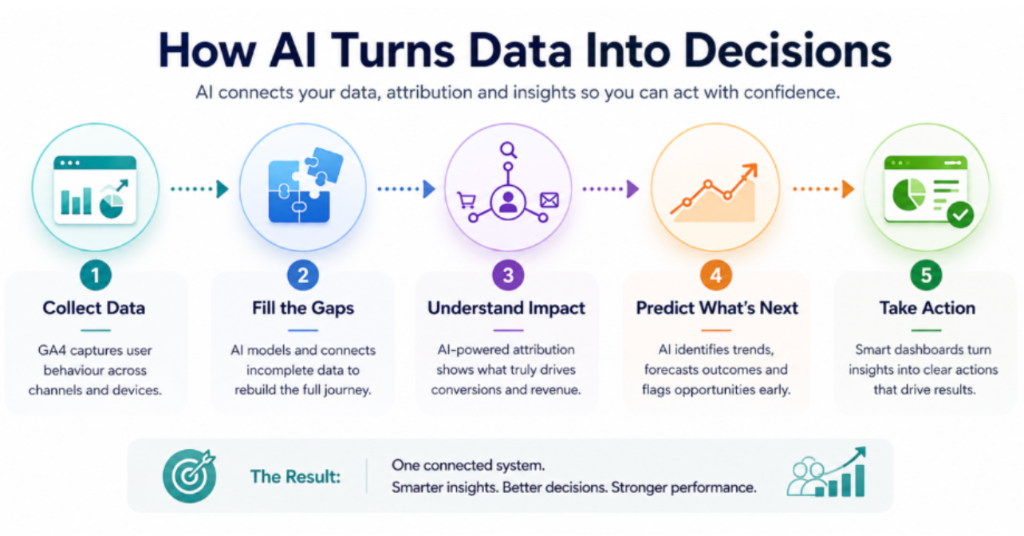
It brings together Google Analytics 4 (GA4) data, including how users arrive, what they engage with and how they move across pages, with attribution that shows what drives conversions and predictive insight that signals where performance is heading.
The shift becomes clearer when you look at how connected reporting supports everyday decisions.
Follow this flow to see how GA4 data, attribution and predictive insight connect:
Getting started does not require a full rebuild. You can build on the reporting foundation you already have, strengthening its support for decision-making.
Start with a clean GA4 setup and clearly defined conversion points, so your data reflects what users do and what drives results. From there, consolidate your reporting into a single view to make performance easier to interpret.
Use AI to get a clearer view of what is happening, then apply those insights to allocate budget more effectively and refine campaigns while they are still active.
Use this to guide your next decisions:
Decision Area | What Changes With AI | What You Do Differently |
|---|---|---|
Budget Allocation | Spend reflects the full journey impact | Invest earlier in channels that build demand |
Campaign Optimisation | Performance signals appear sooner | Adjust campaigns while they run |
Audience Strategy | Behaviour patterns become clearer | Focus on high-intent segments |
Channel Strategy | Channels connect instead of competing | Plan campaigns as a connected system |
Each of these changes shifts how decisions are made across your marketing. Budget moves earlier, campaigns are refined while they run and focus stays on what drives results.

Start by making sure your tracking works properly and that you have defined the actions that matter, so your data reflects what users do and what drives results.
Predictive models show where results are heading before they change. Changes in conversion rate highlight where demand is building or where it may begin to slow, giving you a clearer view of what comes next.
Campaign management becomes more deliberate. Budget is allocated earlier, guided by where results are expected to move.
Strong dashboards show performance changes and guide action.
With strong marketing automation reporting, campaign performance and customer activity come together in one view. Data from paid media, organic channels, and customer relationship management (CRM), which track leads and sales, come together to form a complete picture of performance.
The impact shows in how you make decisions day to day. Clearer insight and better timing give you more control across campaigns, with budget and creative decisions guided by the data.
- Faster decisions: Performance changes become visible sooner, enabling adjustments while campaigns still have momentum.
- Clearer attribution: Each channel’s role across the journey becomes easier to see and act on.
- Stronger forecasting: Predictive signals support more confident planning and budget allocation.
- More focused execution: Less time spent on reporting, more time spent improving performance.
These gains build with each adjustment, improving how the budget is allocated and how campaigns are refined, giving you greater control over how results develop.
The questions below focus on the practical side of applying AI in reporting and analytics, from getting started to improving decision-making.
Start once your GA4 tracking is reliable and your key conversion points are clearly defined. AI performs best when it builds on clean, consistent data.
Focus on attribution and dashboards. These areas improve visibility quickly and have the biggest impact on day-to-day decisions.
Relying on incomplete data and focusing on outputs instead of decisions often limits results.
Your reporting should make your next step clearer, not leave you guessing.
When your data connects properly, it’s easier to see where to focus, what to change and when to take action.
Get our free AI analytics checklist and start building reports that are easier to trust and act on.