Buying decisions can begin before customers reach your website.
Google Shopping ads bring product images, prices and retailer details into view while people actively search for what to buy.
For an ecommerce business, the real question is whether that visibility can turn shopping intent into profitable growth.
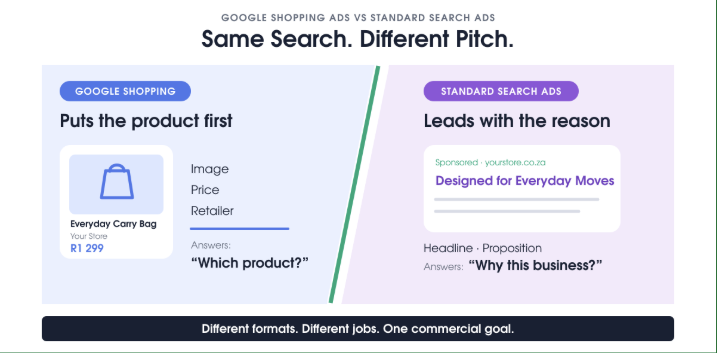
Standard Search ads begin with keywords and written messages. Shopping ads begin with the products you want to sell.
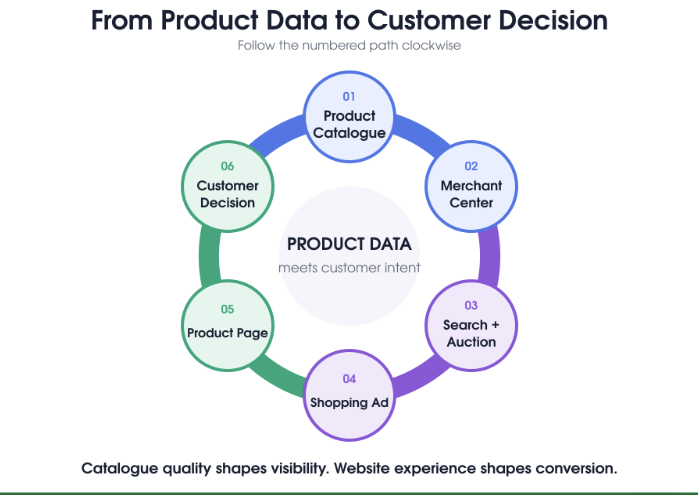
Google uses your catalogue data to understand those products and connect them with relevant searches. Bids, competition and other campaign signals help determine which eligible products appear.
The ad may earn the click, but the product page still has to earn the sale.
Product information moves from your ecommerce website through a product feed to Google Merchant Centre. You can submit the feed directly or connect it through a compatible ecommerce platform.
The platform needs accurate information about each item, including its title, description, image, price, availability and landing page. Keeping those details current gives shoppers a consistent experience from the search result to your store.
Google draws on your Merchant Center product data to create product ads featuring details such as the product image, title, price and retailer name.
Performance Max (PMax) has become the main campaign route for Shopping activity, using the product feed across Google channels. Standard Shopping remains available for advertisers who want more granular control over bidding, product groups and where ads appear.
Unlike a standard Search ad, you do not write a fixed message for every query. Your catalogue provides the content, and Google selects products that relate to the shopper’s search. Product data therefore does more than populate the ad. It influences how clearly Google understands what you sell.
In Google Shopping ads, the product carries the message. Standard Search ads use written copy to give customers a reason to click.
Both form part of Google Ads, but they give businesses different levels of control over what customers see before visiting the website.
The comparison below looks at what those differences mean in practice:
Comparison | Google Shopping | Standard Search Ads |
|---|---|---|
What the Ad Leads With | Shows the product visually using catalogue data | Uses written messaging shaped around selected keywords |
How Google Matches the Ad to a Search | Google interprets product data alongside the customer’s search and campaign signals | Advertiser-selected keywords connect the search with a chosen message |
What Customers Know Before Clicking | They can compare the product, price and retailer from the search results | They understand the wider proposition before exploring the landing page |
Where It Fits in Ecommerce | Captures demand for particular products and categories | Communicates broader brand, category, promotional or service messages |
Many ecommerce strategies use both formats, with the commercial objective determining which takes the lead. Druce Digital’s ecommerce marketing services connect paid media with search strategy, conversion performance and commercial goals, giving each channel a clear purpose.
More budget does not automatically produce better Google Shopping results. Performance depends on how well Google understands your products, how effectively the campaign competes and what customers experience after clicking.
Finding the real constraint matters. Increasing spend won't fix a feed, pricing or website problem.
Clear product data makes it easier for Google to connect your catalogue with relevant searches. It also gives customers more reliable information before they enter your store.
Accuracy keeps products eligible. Optimisation gives Google stronger signals and creates more useful ways to organise the catalogue around commercial priorities.
Important product-data signals include:
- Title structure: brand, product type, key attributes and variant
- Custom labels: grouping by margin, seasonality or campaign priority
- GTIN quality: accurate GTINs and other product identifiers
- Product type taxonomy: addressed as a consistent product type taxonomy
- Accuracy versus optimisation: clearly distinguished in the added paragraph
Missing attributes can restrict eligibility, while weak structure can limit relevance and campaign control. Correct data is the starting point. Feed optimisation improves how Google understands your products and how effectively they can be grouped and promoted.
Eligible products enter the ad auction. Your bidding strategy, available budget, relevance, predicted performance and competitor activity can influence when and where they appear.
Higher bids may create more opportunities, but they cannot repair weak product economics. A campaign can generate sales and still deliver a poor return once you factor in advertising costs and margins.
Customers arrive with expectations shaped by the image, price and product details shown in the ad. The product page needs to reflect what they saw before clicking.
Relevant content, competitive pricing, delivery information, mobile usability and a straightforward checkout all influence whether interest becomes a sale.
When traffic rises without a similar improvement in revenue, the customer experience needs the same attention as campaign performance. Your website still has to complete the purchase journey.
Google Shopping can connect your products with high-intent searches, but demand alone does not make a campaign commercially viable. Your margins, budget, website and ability to manage performance all matter.
Consider whether your business has:
- Products with identifiable search demand
- Margins that can absorb paid acquisition costs
- A realistic advertising and testing budget
- Accurate product information that stays current
- Clear revenue, return or acquisition goals
- Conversion tracking that connects spend with results
- Time and expertise for ongoing campaign management
Google Shopping ads raise practical questions about how the format works and what it can deliver for an ecommerce business.
Google uses catalogue data, the customer’s search and auction signals to determine which eligible products appear. Shoppers can then click through to the relevant product page.
They can be when the commercial return justifies the advertising cost. Profit and acquisition cost provide a clearer measure than clicks or revenue alone.
Google Ads is the wider advertising platform, covering Search, Shopping and other campaign formats. Google Shopping is a visual, catalogue-based format designed to promote individual products.
Picture your products appearing just as customers are ready to choose. A focused shopping strategy can turn that moment into measurable growth.
Explore Druce Digital’s PPC services and build your campaign around the returns your business needs.